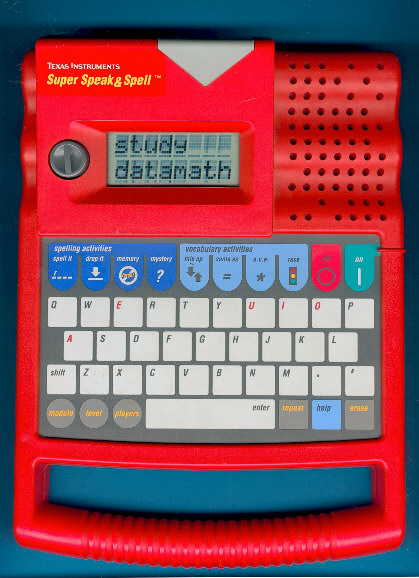
My spelling computer also contributed massively to my learning literacy development in early years. My mum bought me the spelling computer when I was in year 2. I have always had trouble with spelling and I still do, however, this early spelling computer contributed a lot to my spelling development and the placement of letters within words.
The spelling computer was made by Texas Instruments called “Super Speak & Spell”. It had four spelling activities and four vocabulary exercises. The computer makes spelling into a game, which is more appealing for children. Spelling then becomes fun; it is not boring or tiresome if it is a fun game that you can also learn off. Besides including a basic spelling game the spelling activities also included a memory activity which would help children use their long term memory skills.
The only negative problem with the spelling computer was that there were a few words that had an American spelling. This was because it was American program which i had in the early 1990’s. Today these spelling programs can be altered to your own countries standard English.
New programs were available on different cartridges for the spelling machines and they were also available for maths. I ended up finishing the program that was on it and so did my mother. It helped us to be cooperative learners, while also developing my spelling and memory development.
There are many ways of learning spelling. I think a good teacher will try variable methods to find the best and more suitable for the children of their class. I believe that the Super Speak and Spell's memory methods work on one level, but may not work for all children. They also could not explain the definition of the word.
In researching about spelling I came across Word Work. This program is a more in depth look at word construction. Williams (2009) states that Word Work (or Word Study) is aimed to "help students actively explore these layers of information. when studying the alphabetic layer, students examine the relationship between letters and sounds, and in doing so, to create words. When studying the pattern layer, they look beyond single or paired letter sounds to search for larger patterns that guide the grouping of letters. Studying the meaning layer helps students to understand the English spelling system can directly reflect the semantic relationships across related words."
By looking at this approach it could help students develop a deeper understanding of spelling and literacy functions. But this does not mean that smaller things (like the Speak & Spell) do not contribute to children's learning development.
References
Williams, C. (2009). Word study: instruction in the K-2 classroom. The Reading Teacher, 65, 570-579


No comments:
Post a Comment