Thursday, March 18, 2010

Conclusions


In researching my literacy developments I have gained new appreciation of the literacy triptych. I can relate the triptych to my own learning progress.

My reading problems are a good example of functional literacy. Anstey and Bull (2001) tell an example of education in the 1990’s was a time to use "natural methods of learning language (i.e. similar to those used in home when children first learn language)".

As my reading language developed I became acutely aware that I was developing my critical literacy. I think I did not recognise that I was analysing images from an early age. By creating these images I was good at understanding meanings of visual texts.

It then became very evident as I became an acute decoder and critical analyse for films. I was able to decipher meanings from a more abstract visual text; such as films by David Lynch, which are heavily driven by visuals. I could identify the meanings behind colours, emotions and words without a path to their direct context.

Heath (2004) talks about how the arts can influence literacy development “Students involved in the arts create mental images of themselves and their products or performances, and they rehearse processes surrounding these self-perceptions. They spend a large portion of each week in the sustained visual focus demanded during practice sessions with professional artists. Looking and thinking.”

“As they work on individual pieces or in collaborative pursuits, they review (often quite literally re-viewing) what they had seen earlier by consulting a book or videofilm or by returning to a gallery or museum. They also reflect (sometimes trying to re-create what they have seen) on past observations and project ahead to their planned performance or production."

Reflection is a key to literacy development. Art lets you explore your own ideas and others to gain an understanding through an image. Art is a very powerful format, as visual literacy is finally becoming more recognised.

This came hand in hand with my cultural literacy development. As my understanding of words came into place I learned more about myself in my own world, and therefore was learning about others cultures through school and outside texts.

I think my devotion and engagement of visual images helped me interpret different relationships of cultures.

During my early years I think my mother’s influence had a huge affect on my literacy development. I think it is a prosperous expansion to have parents closely linked to the learning of children and the child's school.

Shek (2001) states that "Home-school partnership has been recognized as an important approach to promote student learning since the last century. Though families bear an inevitable role to teach reading at home, teachers and parent volunteers working together at school may motivate those students who are uninterested or less supported by their families to read. The interests of the current readers may also be strengthened."

It is therefore evident on how integral early literacy learning is to any students life. There should be reinforcement of learning at home, as well as a respect for the knowledge acquired within books.

My early development of reading contributed to my critical understandings of various texts and vice versa. As Stephen D. Krashen wrote in Every Person a Reader, "Literature is applied philosophy. It includes ethics, how we are supposed to live, and metaphysics, speculations on why we are here. Fiction is a very powerful way of teaching philosophy. Good stories help us reflect on our behaviour and our lives."

The idea of the triptych is found often throughout life and can be experienced on many levels. We can understand the meaning of the triptych alone. But without a cultural viewpoint we can’t understand it in our full view. By looking at this example we are presented with a work that can tell three stories and one also as a whole, full story. But without the knowledge of what the painting is about we cannot full interpret the paintings comprehensive meaning.


References
Books

- Anstey, M., Bull, G. (2004). The Literacy Labyrinth (2nd ed.) French Forest, NSW: Pearson Education Australia.
- Krashen, S. D. (1996). Every Person a Reader: an alternative to the California task force report on reading. California: Language Education Associates

Journal Articles

- Heath, S. B. (2004). Learning language and strategic thinking through the arts. Reading Research Quarterly, 39, 338-342
- Padak, N., Rasinski, T. (2006) Home-school partnerships in literacy education: From rhetoric to reality. The Reading Teacher, 60, 292-297
- Schneider, D. (2010). Why read books anymore? Book Links, 19, 17
- Shek, J. (2007). Home-school partnership: parent-child morning reading programme. International Association of School Librarianship. Selected papers from the Annual Conference, 1-6

Saturday, March 13, 2010

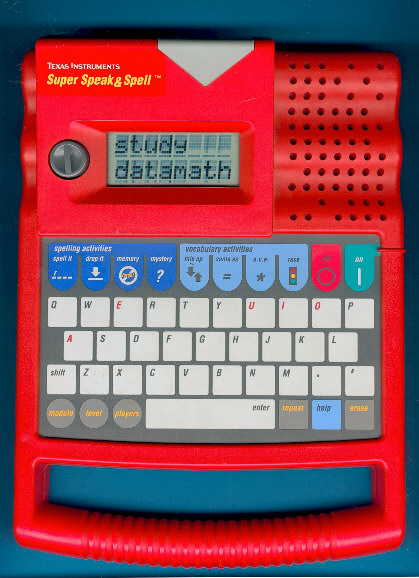
Super Speak & Spell


My spelling computer also contributed massively to my learning literacy development in early years. My mum bought me the spelling computer when I was in year 2. I have always had trouble with spelling and I still do, however, this early spelling computer contributed a lot to my spelling development and the placement of letters within words.

The spelling computer was made by Texas Instruments called “Super Speak & Spell”. It had four spelling activities and four vocabulary exercises. The computer makes spelling into a game, which is more appealing for children. Spelling then becomes fun; it is not boring or tiresome if it is a fun game that you can also learn off. Besides including a basic spelling game the spelling activities also included a memory activity which would help children use their long term memory skills.

The only negative problem with the spelling computer was that there were a few words that had an American spelling. This was because it was American program which i had in the early 1990’s. Today these spelling programs can be altered to your own countries standard English.

New programs were available on different cartridges for the spelling machines and they were also available for maths. I ended up finishing the program that was on it and so did my mother. It helped us to be cooperative learners, while also developing my spelling and memory development.


There are many ways of learning spelling. I think a good teacher will try variable methods to find the best and more suitable for the children of their class. I believe that the Super Speak and Spell's memory methods work on one level, but may not work for all children. They also could not explain the definition of the word.

In researching about spelling I came across Word Work. This program is a more in depth look at word construction. Williams (2009) states that Word Work (or Word Study) is aimed to "help students actively explore these layers of information. when studying the alphabetic layer, students examine the relationship between letters and sounds, and in doing so, to create words. When studying the pattern layer, they look beyond single or paired letter sounds to search for larger patterns that guide the grouping of letters. Studying the meaning layer helps students to understand the English spelling system can directly reflect the semantic relationships across related words."

By looking at this approach it could help students develop a deeper understanding of spelling and literacy functions. But this does not mean that smaller things (like the Speak & Spell) do not contribute to children's learning development.

References
Williams, C. (2009). Word study: instruction in the K-2 classroom. The Reading Teacher, 65, 570-579


Friday, March 12, 2010

Flash Cards


During my early reading development my mother was advised by the school to try using flash cards. This was before the reading program commenced, but it also connected to my early functional learning.


Flash cards were another small concept that was an activity to help students with reading problems. It was designed for parents to do at home with their children. My mother created her own cards for me. The cards had one word on them and there was about 20 cards (more could be made). The cards featured the word only and no picture. The 20 cards would be used for a period of time, until I was familiar with all the words. This was used every afternoon as a contributing part to my learning which helped me progress into reading.

Flash cards can be a useful and simple tool for children to identify words with. It's cheap an effective way for children to remember words and what the word looks like. It also gives parents/teachers a way to communicate a meaning that is instantly connected to the word.


I found these videos to be helpful in explaining how flash cards can work. These are not only for home-schooling, but could be done after school or even in school.

Tuesday, March 9, 2010

Reading Problems


When thinking about my personal literacy problems, I immediately think back to primary school. I myself started school in 1990 at the age of 4. By year two, all students who were a year younger got the option to repeat and be in a similar age-group. Some students whose parents did not want to hold them back stayed in the same year while other students were pulled back. These students were not pulled back because of their classroom knowledge (one of the students who repeated with me is now a Forensic Scientist), but were held back by their age. This would have helped in the learning process, because I would have gained an extra year to use metacognition in helping myself to read.

Reading programs were set in the school, during school hours. Reading sessions would be on Monday for 60 minutes. They were incorporated into the school life to benefit children’s learning. Which I think is a big responsibility that good primary schools have to undertake. The basic levels of primary learning that need to be established at an early age as a foundation for future learning.

The reading program at Dudley Primary School was run by the parents of students. So the learning was all kept in house and was voluntary. This was also a good learning experience for the parent’s as well as the children as they got to interact with children, as their own child to benefit their learning and therefore become quality readers. Parents gained a sense of fulfilment and aspects to help future teaching skills with their children. My mother was one of the parents involved in the Reading program. She had a lot to do with my continual progress.

The program was not complicated or prestigious, rather it was simple in the fact that one parent and one child would sit and read. The child would be reading a book to their personal ability and the parent would be helping them with difficult words. If a child had difficulty pronouncing a word parents would sound them out so students could mimic and try again. When a child did not comprehend a word, the parent would then give a definition so that deep understanding could occur. By defining a word and its meaning within a preconceived context it makes the comprehension easier. By simply defining a word without placing it within a sentence or context would not be received as well.

Outside the education institution I was continuing in my reading development. My mother would sit down with me every afternoon after school and we would read together. We would take turns in reading so I would not be reading on my own. She helped me a great deal in my learning progress. I would not be as good of a reader today without the help of my mother. Dr Seuss was a popular choice during the fundamental learning period. I participated in the reading program at school for two years, but I continued to read at home.

By the time the reading exam came around in year six, I was reading far above my age level. I had read the most books in the class (the book chart had to be expanded for me). At the age of 12 I was reading to the capacity and understanding of a 15 year old.

I was always fond of books, before I could even read. Even though I am very much a visual learner, books always enticed me. Once I got a hold on the reading curb, I quickly stepped up to the mark. I remember fondly the beginnings of early reader obsession when I started to read books on my own at the age of 9. Goosebumps my choice of book, as it was with a lot of young children in the mid nineties. I was drawn to Goosebumps and I always enjoyed thrills and chills, liking horror and adventure from an early age. My obsession did not stop there; I then went onto Sweet Valley High, Fear Street and other teen novels. Only to find my literacy true love was to be found in the words of Stephen King. I read my first King book at the age of 15, starting with “IT” which spawned over 1100 pages.

By my twenties and as my love for film expanded, I turned to more unusual titles such as Fear and Loathing in Las Vegas, American Psycho and Naked Lunch.


In reasearching about my Reading Programs I came across a letter titled Ten Myths of Reading Instruction.

I would like to draw attention to Myth 3 and Myth 9.

Myth 3: Reading programs are “successful”

Myth 3 states: “Although such reading programs can be a useful part of a larger reading curriculum, no reading program by itself has ever been shown to be truly "successful"— not with all children and all teachers. And no reading program by itself has been shown to accelerate all children to advanced levels of performance.”

There in fact identifies that no teaching structure of literacy’s can be perfect for all students, but I do think that a reading program implemented within a school and supported by parents outside school time would be beneficial to a lot of children undergoing reading problems

Myth 9: Short-term tutoring for struggling readers can help them catch up with their peers, and the gains made will be sustained.

Myth 9 states: “But it is evident that such gains as are made by children in these programs are not sustained for very long once they are exited from the program. Studies of pull-out tutoring programs have shown that children who are not thriving like their peers in the classroom continue to fail to thrive when they are placed back in that classroom full time.

I disagree with this statement. In conjunction to myself I find it definitely untrue. Whether my experience is problematic of not, I am not sure. I think it could be in result of the inconsistency of the reading program over a few weeks, but having it accessible for students over a longer period of time to ensure that sustainable development has occurred.

Another attributing factor is offcourse the continuation of reading after school hours is that I had help from my mother. There seems to be blatant blaming on teachers for poor student literacy’s. But education is not just within the classroom and should be reinforced at home, especially for struggling students.

Myth 9 states: “Studies have shown that the best hope for these children is to place them with a "strong" reading teacher full time — a teacher who has a sophisticated understanding of the process of learning to read, a tendency to use assessment data to inform individualized instruction, and a talent for engaging students in focused and interesting instructional activities.”

Again, this almost states that students with learning problems are disinterested children. I find these expansions of myths to be false.


Saturday, March 6, 2010

Background Information


Before dwelling into my autobiography of my literacy experiences, I thought a brief history of myself and my family would be an adequate starting place.

Born in 1985, by family was not born not into privilege or education. None of my initial family, or even larger family circles from both sides had finished school. It is not to say that education wasn’t valued in their family. But more so, it was not a means of survival, like it has become today.

I was the first child from the large family circle to complete the HSC. Not that my learning was ever easy, my learning and learning abilities was always a constant struggle. This was not due to the fact of not wanting to learn; in fact it was quite the opposite. My willingness and determination to learn was what got me through high school, and what is pushing me through university today.

I’ve always been heavily creative, excelling in Visual Arts and Photography at high school. It was always the theoretical education that caused me more trouble. I always had to work my hardest in school. Sometimes it payed off, and sometimes it didn’t. Not having an extremely knowledgeable family did make certain encounters harder after a particular age. In early years, I pushed through with a lot of help from my mother, to a Maths tutor in senior years. It was my determination to be something better that was driven into my core and also by my parents.

After high school I went to TAFE for two years to study in Film/TV which I loved immensely. Film was a creative release for me, not just in its making, but in deciphering hidden agendas by signs and symbols in the visual image.

While studying at TAFE I found a love in Makeup, which I then completed a course in. I became a freelance makeup artist. I do work for films, TV as well as participating in other roles on set.

Worried about having a steady future I saught into a sturdy career that I preconceived at high school, a visual arts teacher. I began in 2007 by undertaking Bachelor of Teaching/Bachelor of Fine Art. At university I had to deal back into problems I encountered at high school, but had forgotten at TAFE. Besides having to expand my thoughts and question my abilities, I also had to regroup myself within the fact of social politics.

I am currently in my final year at university.